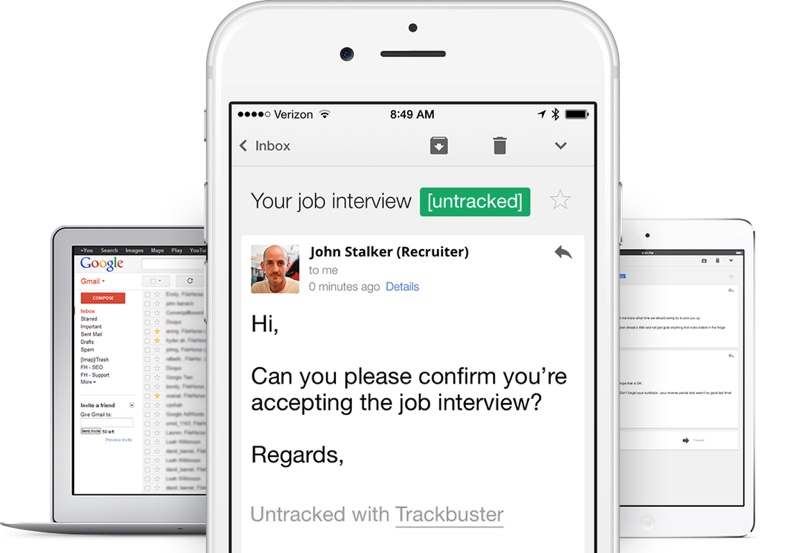
Email trackers usually embed a tracking code within the email. When a tracked email is opened, the tracking code requests resources from the tracking servers, letting them know about the exact time, location and duration for which the email was accessed. If the Mail app that comes with your Mac doesn't provide the features you need, you're in luck. There are dozens of great email apps in the Mac App Store. I've tested many of them and these are my favorites.
'I just came across this email,' began the message, a long overdue reply. But I knew the sender was lying. He’d opened my email nearly six months ago. In Palo Alto. I knew this because I was running the email tracking service, which notified me as soon as my message had been opened. It told me where, when, and on what kind of device it was read. With Streak enabled, I felt like an inside trader whenever I glanced at my inbox, privy to details that gave me maybe a little too much information.
And I certainly wasn’t alone. There are some sent and received daily.
Safe torrent for mac? reddit. That’s roughly 35 emails for every person on the planet, every day. Over 40 percent of those emails are tracked, according to a published last June by OMC, an “email intelligence” company that also builds anti-tracking tools. The tech is pretty simple. Tracking clients embed a line of code in the body of an email—usually in a 1x1 pixel image, so tiny it's invisible, but also in elements like hyperlinks and custom fonts.
When a recipient opens the email, the tracking client recognizes that pixel has been downloaded, as well as where and on what device. Newsletter services, marketers, and advertisers have used the technique for years, to collect data about their open rates; major tech companies like Facebook and Twitter followed suit in their ongoing quest to profile and predict our behavior online.
But lately, a surprising—and growing—number of tracked emails are being sent not from corporations, but acquaintances. “We have been in touch with users that were tracked by their spouses, business partners, competitors,” says Florian Seroussi, the founder of OMC. “It's the wild, wild west out there.” According to OMC's data, a full 19 percent of all “conversational” email is now tracked. That’s one in five of the emails you get from your friends. And you probably never noticed.
“Surprisingly, while there is a vast literature on web tracking, email tracking has seen little research,” noted an published by three Princeton computer scientists. All of this means that billions of emails are sent every day to millions of people who have never consented in any way to be tracked, but are being tracked nonetheless. And Seroussi believes that some, at least, are in serious danger as a result. As recently as the mid-2000s, email tracking was almost entirely unknown to the mainstream public. Then in 2006, an early tracking service called made waves when a lawsuit revealed that HP had used the product to trace the origins of. The intrusiveness (and simplicity) of the tactic came as something of a shock, even though newsletter services, salespeople, and marketers had long used email tracking to gather data.