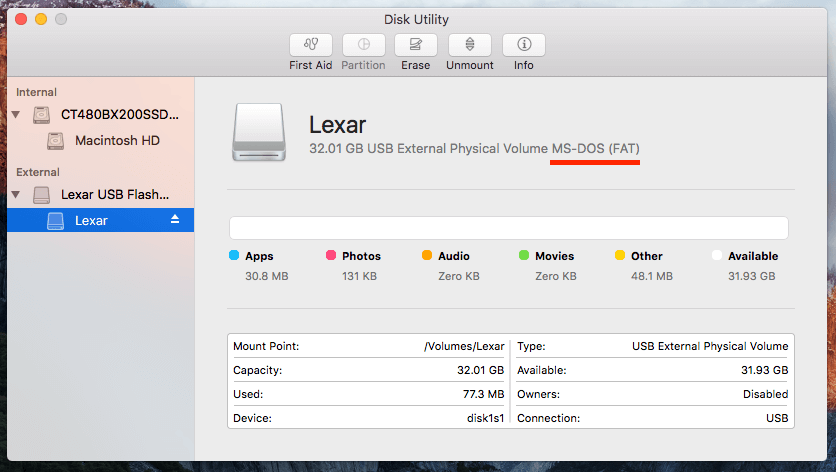
Step by step guide show you how to format flash drive through USB, Firewire or Thunderbolt on mac for free and safe. Recall email in outlook for mac. Connect the hard drive or USB key to the Mac 2. Launch Disk Utility, located in Applications > Utilities 3. Locate the drive name from the left hand side of Disk Utility and click on it 4. Format An External Hard Drive/ USB Flash Drive for Mac OS X: The Process is very much simple only you need to know that all your data will be erased and will Partition the disk. Connect the hard drive or USB key to the Mac.

• If you want to share your files with the most devices and none of the files are larger than 4 GB, choose FAT32. • If you have files larger than 4 GB, but still want pretty good support across devices, choose exFAT. • If you have files larger than 4 GB and mostly share with Windows PCs, choose NTFS. • If you have files larger than 4 GB and mostly share with Macs, choose HFS+ are the sort of thing that many computer users take for granted. The most common file systems are on Windows, APFS and HFS+ on macOS, and EXT on Linux—though you may run into others on occasion. But it can be confusing understanding what devices and operating systems supports which file systems—especially when all you want to do is transfer some files or keep your collection readable by all the devices you use. So, let’s take a look at the major file systems and hopefully, you can figure out the best solution for formatting your USB drive.
Flash player 10.2 for mac os x. Understanding File System Problems Different file systems offer different ways of organizing data on a disk. Since only binary data is actually written to disks, the file systems provide a way to translate the physical recordings on a disk to the format read by an OS. Since these file systems are key to the operating system making sense of the data, an OS cannot read data off of a disk without support for the file system with which the disk is formatted. When you format a disk, the file system you choose essentially governs which devices can read or write to the disk. Many businesses and households have multiple PCs of different types in their home—Windows, macOS, and Linux being the most common. And if you carry files to friends houses or when you travel, you never know what type of system you may want those files on.
Because of this variety, you need to format portable disks so that they can move easily between the different operating systems you expect to use. But to make that decision, you need to understand the two major factors that can affect your file system choice: portability and file size limits. We’re going to take a look at these two factors as they relate to the most common file systems: • NTFS: The NT File System (NTFS) is the file system that modern Windows versions use by default.
• HFS+: The Hierarchical File System (HFS+) is the file system modern macOS versions use by default. • APFS: The proprietary Apple file system developed as a replacement for HFS+, with a focus on flash drives, SSDs, and encryption. APFS was released with iOS 10.3 and macOS 10.13, and will become the mandatory file system for those operating systems. • FAT32: The File Allocation Table 32 (FAT32) was the standard Windows file system before NTFS. • exFAT: The extended File Allocation Table (exFAT) builds on FAT32 and offers a lightweight system without all the overhead of NTFS. • EXT 2, 3, & 4: The extended file system (EXT) was the first file system created specifically for the Linux kernel.