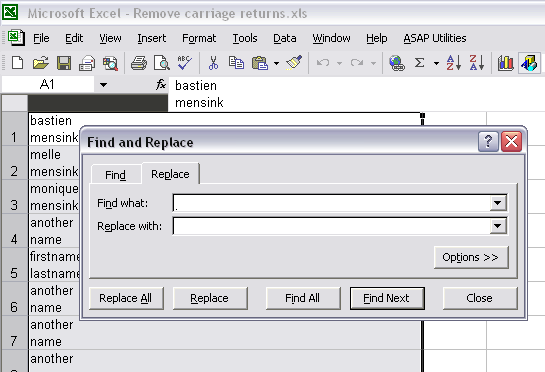
The answer is to use Control+Option+Enter, which will create a line break in the cell. As an alternative, Control + Command + Enter can also be used to achieve the same. These combinations work both in Excel for Mac 2011 and the new Excel for Mac 2015.
I mean, this is Excel we’re talking about here. Hitting the Delete key is supposed to delete the contents of the active cell, for cryin’ out loud. In Excel for Mac it does that, but the cursor also gets stuck inside the cell in edit mode. You have to hit the enter key to finish deleting the contents, but this act also moves the active cell to the next cell down. And if you’ve selected a range and hit the Delete key, the active cell contents are deleted and the cursor is stuck inside the cell in edit mode. You have to hit the Enter key, which does nothing but take you to the next cell. The range contents are still there, with the exception of the active cell.
Anyone searching for a Mac Tools franchise for sale need only click or call to connect with one of our experienced recruiters. These experts can tell you about the opportunities for running a Mac Tools tool truck in your area, and determine whether you are qualified. Mac Tools has franchises for sale nationwide, providing opportunities for entrepreneurs to build businesses they can be proud of. As a tool truck owner, you'll bring world-class automotive tools to technicians throughout your area and build relationships with these professionals to ensure that they have what they need to keep vehicles on the road throughout your community. The franchisee will receive the right to operate a business involving the mobile sale of professional automotive tools and similar products manufactured and/or distributed by Mac Tools and bearing the MAC Tools trademarks. Mac tool franchise for sale by owner.
Not the kind of behavior that occurs in Excel for Windows. How to Delete Cell and Range Contents in Excel for Mac The trick is to remember that fn+Delete is really a keyboard shortcut to the Delete key on a Mac. Then the world rights itself and the planets align. Frustration abates.
You’ve finally found the magic. Your mojo is back! Watch this 54 second video to see what I’ve been babbling about for the past 454 words.
• I know this is an old thread, but I just spent the last few weeks assembling a list of Windows and Mac Excel shortcuts. Right now, the list is just over 200* shortcuts: Seems like every time I look at the list, I find a problem to fix, but it’s a start. Hope it’s useful for those who need to use both platforms. * I took a pretty granular approach, so some shortcuts are near duplicates (e.g. Selecting columns in a table and selecting columns in the worksheet are listed separately, but the behavior is a little different).
• Phil Paradis Note that there is a Windows-style “Delete” key on the full-size Mac keyboards, in it’s usual place to the left of the End key. (It’s labeled with a funny-looking symbol instead of “Delete”, and is referred to in most documentation as “Forward Delete”.) This key functions exactly as Delete on a Windows keyboard and Fn-Delete on the laptop/wireless Mac keyboards. The full-size model also has a 10-key number pad for those who prefer them, though some of the operator keys are misplaced relative to the PC layout which can take some getting used to.
Thank you very much You can see by the steady stream of “thank you” replies (more than 18 months now) that this is much needed and hard-to-find tip. Just for a moment, consider how much time it took to offer this advice and then the resultant positive impact on so many people (imagine the countless many that have benefited but did not write their thanks).
This might seem to overstate this. But how many individuals were out there tearing their hair out as a deadline was bearing down on them only to have this stupid little frustration get in their way. Well done, and again, thank you.
It is such a pain that Excel in Mac is so different from Windows. I find the Mac version very awkward.