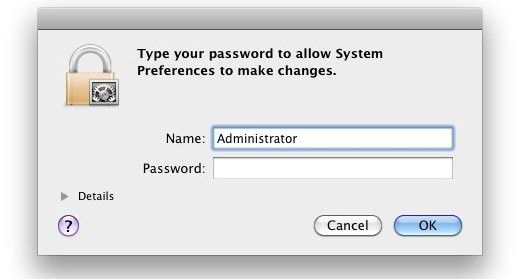
If you cannot set an account to admin, then you will need to reboot into single user mode (hold Cmd-S while starting up your Mac). When you get to the command line (black screen, white text) type: When you get to the command line (black screen, white text) type. For example, to log on as local administrator, just type. Administrator in the User name box. The dot is an alias that Windows recognizes as the local computer. The dot is an alias that Windows recognizes as the local computer.
We know in OS X a local administrator also don't have the right to access other users' home folder, such as Desktop and Documents. If you try to click on them, you will see a red minus and it says you don't have permission to access it. There is another thread talking about going to 'Get info' on the folder and change permission that way. But it doesn't change the sub folder.
So I end up trying to use chmod -R command to change the permission on /users. However, I have two problems: 1. I don't know the correct syntax to use to just give Local Admin RW right using chmod command. It looks like I am giving everyone or domain admin the full access. I can't get this right. Even you have given the full access to Local Admin to the /Users folder, when a new AD user logs in to the computer first time, his home folder will become unaccessible to Admin again. And I have to chmod again.
Any other way to get this done besides setting this command as login policy? Somehow my MAC stucks at 'Apply Policy' for minutes if there are any login policies. This isn't Mac OS 9 anymore: • If you're already an administrator you can access user files any time you need. Administrators don't need to change user folder permissions to grant themselves access because they can elevate themselves to root.
• Being an administrator doesn't mean you should give yourself carte blanche to everything under your purview. Yes, as an administrator you can do this, but that doesn't mean you should. If you need to gain access to a user's files because he has left the company or because your HR has reason to locate some data then that's when you exercise your administrative credentials. You don't do it beforehand.
Hi talkingmoose, Thanks for your reply. But that didn't really answer my question.
I work in the school. All students log in MAC using their AD credentials. After they save their work on the Desktop, teachers need to be able to check these files to monitor the progress. That's why I wanted to create a local admin account on each MAC, which will be used by teacher to access other users' folder.
Realplayer downloader for mac 12.0 download. RealPlayer SP for Mac OS X version is similar to RealPlayer for Windows, playing RealAudio/RealVideo and supporting QuickTime media, AAC, MP3 and Windows Media. • If you, RealPlayer basic is yours to keep! RealPlayer for Mac. Some features of RealPlayer for Mac OS X are: • Near DVD-Quality Video - Crisp, clean video quality of RealVideo® 10 with any Internet connection. • If you like SuperPass, simply don't cancel and you will start paying the $12.99/mo subscription fee after the 14-day trial.
I am running 10.6.8 in our environment. All the iMACs have been joined Active Directory. What I find is that the local admin account cannot access other users' home folder.
They all have a red minus and when you click on it, it says you do not have permission. This doesn't happen with Root user but does happen with Admin accounts. My point is that I feel you're handling this issue incorrectly. The idea behind running as an administrator is that you are still working like a Standard user but can at any time elevate your privileges. If your administrators don't know how to access files that are inaccessible to them in the GUI then they probably don't need to be administrators. As Sally and I have said, shared folders or server shares are for allowing everyone to share files. User home folders belong to each user.
As a best practice they shouldn't be made easily accessible to anyone else including administrators. We had a similar situation where we had a teacher who was an admin on the lab computers. She would login as root to access students folder to view their work (Video Lab Class).
When were started removing admin rights from our teachers she still wanted access to the students' home folders. We ended up running this at each login to give the teacher access. I'm no expert here but maybe this will work for you. ### Replace USER/GROUP with the actual User or Group ### Replace FOLDER with the actual FOLDER ### Add -R before the +a to make it apply to all folders already in that Folder chmod +a 'USER/GROUP allow read,list,search,add_file,add_subdirectory,delete_child,file_inherit,directory_inherit' FOLDER Kenny. Thanks guys for your replies.
Really appreaciate. We have a share facility in place. But we want the student work from local because their files are huge, usually 1 to 2 GB. We don't want 25 students editing video from the same share server at the same time. For the same reason, we only use the share drive for students to submit final work.
Kids are not patient enough to upload their work to server after every class. So when the teacher want to monitor their process, he needs to log in to the local computer check student's work. I think for now I will ask the teacher to log in as Root user. Thanks Kenny for your little trick. I have to test it on Monday. But the problem with AD users is: Even you give full permission to an admin account to access users' home folder, when another new AD user logs in and created a new home folder, it will become unaccessible to the admin again. So you have to start again to use CHMOD.