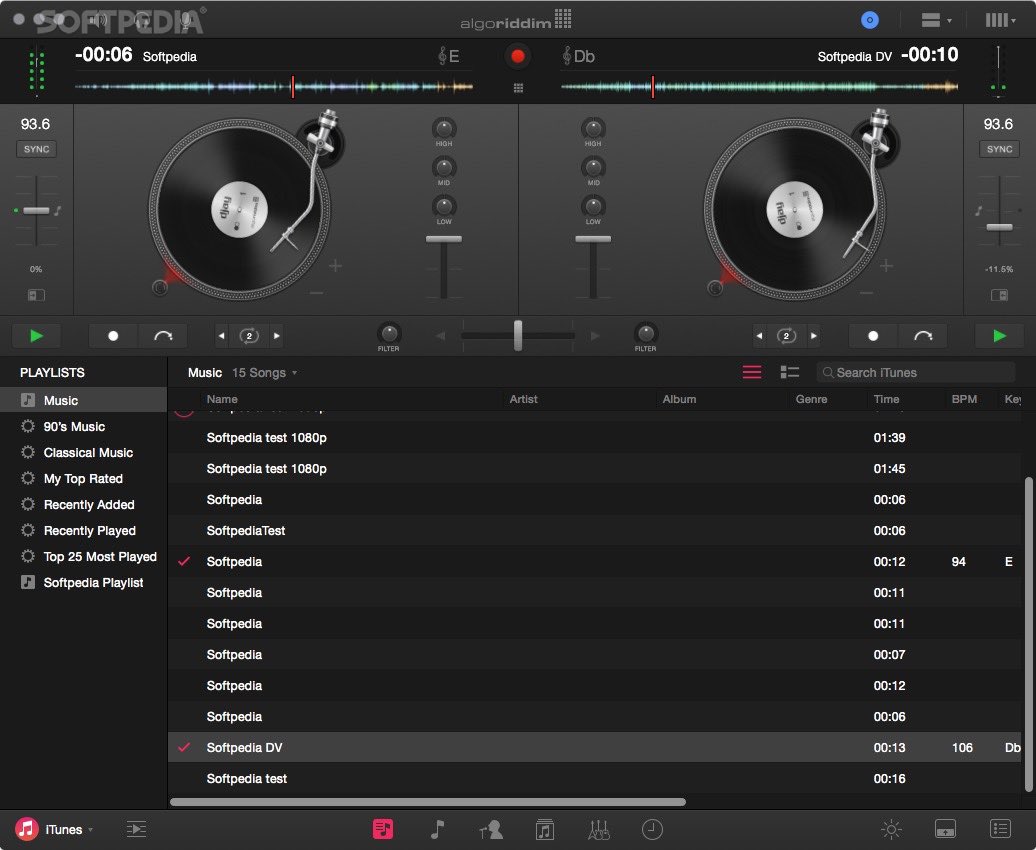
's djay lineup has been a mainstay in the DJ app market, getting its start on the Mac over ten years ago, becoming one of the early iPad hits, and over the years expanding to also include iPhone, Apple Watch, Windows, and Android. Throughout that time, djay has proven extremely popular with professional, amateur, and aspiring DJs alike for its powerful yet intuitive tools that make it easy to replace physical media and turntables with a single computer or mobile device, making djay the world's best-selling DJ app with over 30 million downloads while also winning a pair of Apple Design Awards.
Three years ago, the Mac version of djay, gaining a revamped interface, integration with Spotify, and a host of other new features, and Algoriddim has continued to make improvements in the app since that time, most notably with an on-stage demo at where Algoriddim showed off Touch Bar support for djay Pro on the redesigned MacBook Pro. Today, Algoriddim is launching, a major update bringing quite a few features that not only improve the user experience today but also set the stage for more advancements down the road. We met up with Algoriddim's Michael Simmons and Christoph Teschner last week for an in-person demo and overview of the new features, and we came away impressed with the update.
Discover alternatives, similar and related products to djay pro-for-mac that everyone is talking about. 4 alternative and related products to djay Pro (for Mac). Under its sleek, elegant surface, djay Pro for Mac punches a real pro punch, with all-new FX, four decks including full parallel waveform display, and tight Also you can store your Spotify playlists locally for offline use with the premium account which you need anyway in order to use it with DJaY. How do you reset a font default size on microsoft office for mac version 2017 windows 10.

The biggest feature Algoriddim has brought to djay Pro 2 for Mac is Automix AI, a massive improvement to the app's existing tools for creating automatic, beat-matched mixes of your songs. Machine learning and artificial intelligence are obviously hot topics these days, and Algoriddim is leveraging those technologies to make transitions between songs even more seamless. With Automix AI, djay Pro 2 automatically scans the current and upcoming song, identifying the best sections of the two songs to facilitate fading between the outro of one and the intro of the next. Automix AI automatically optimizes EQs and filters for each transition, and the Morph functionality keeps beats and tempos match throughout the transition. Pairing Morph with the Match song recommendation engine from Spotify gives users a seamlessly mixed automatic playlist that helps them discover new music, but also lets users take over manual control at any time. Algoriddim sees itself on the forefront of bringing AI technology to music, said Simmons, wondering out loud why Apple Music, Spotify, and other music services haven't jumped on the opportunity to use AI to recommend songs and create mixes for their own users.
Teschner pointed to workout playlists as a prime opportunity for this sort of feature, where AI could build a seamless mix of songs to eliminate dead time between tracks and awkward transitions, keeping your energy and momentum going. It's clear Apple has some interest in this area, given the company's long partnership and just-announced. The music recognition abilities of Shazam can certainly serve as the basis for such a feature, automatically scanning and identifying songs to help match tracks that complement each other and flow well together, something Algoriddim has already spent years refining. Perhaps my favorite feature for the casual user is the new PhotoBeat functionality that makes it simple to create a photo slideshow set to music. Integrating directly with your Photos library and building on a similar video feature from the original djay Pro, PhotoBeat in djay Pro 2 lets you pick albums, moments, or even hand-selected photos, and set them to music. Photo transitions happen in time with the beat of the song, and you can customize the transitions on-the-fly from a quarter of a beat per photo all the way up to four beats per photo.